

Emails with deceptively genuine invoices, forged senders or supposed password updates: phishing is now the most common form of attack on Swiss companies. According to studies, around 90% of all cyber incidents begin with a single thoughtless click, as confirmed by current figures from the BACS, with 6643 reports in the first half of 2024.
Technical safeguards such as spam filters or firewalls are important, but they act too late once an employee clicks a link or discloses data. This is where phishing simulations come in: targeted test attacks that train security awareness in a realistic way.
But are such training sessions really worthwhile? Or are they just another tool that attracts attention in the short term but achieves little in the long run?
Why phishing simulations matter for Swiss companies
Swiss SMEs are an attractive target, precisely because they are often well organised but not systematically trained. While IT systems are increasingly secured, the “human factor” often remains the weakest point.
Typical situations:
- Employees receive deceptively genuine emails with supposed Office or service provider links
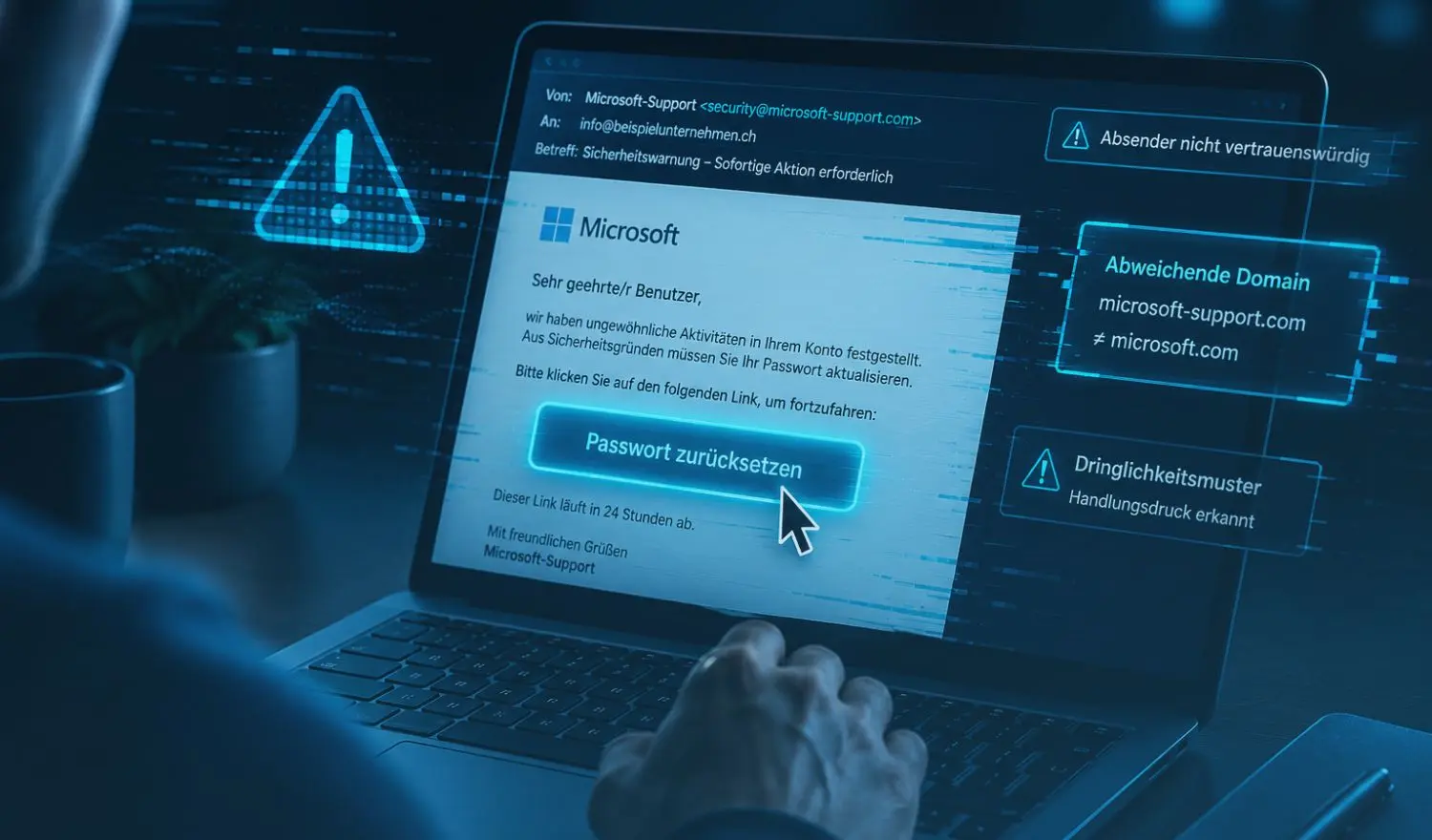
- Password resets or security warnings look credible
- Invoice approvals or HR requests are answered without scrutiny
The consequences: malware downloads, ransomware infections or the loss of sensitive customer data. Phishing simulations offer a controlled learning environment: instead of becoming victims in a real attack, employees experience in a safe setting how convincing attacks can look, and learn to spot warning signs early.
How phishing simulations work and what matters
A phishing simulation in a company is not a “game of fear” but a targeted awareness tool. The process usually follows four steps:
- Planning and defining objectives
Which departments should be tested? What is the goal: raising awareness, measuring or training?
It is important to communicate the exercise not as a sign of distrust, but as part of your security culture. - Creating realistic but fair phishing emails
Good simulations use realistic scenarios that could occur in everyday work, such as fake Microsoft login pages, alleged delivery notifications or internal announcements.
Exaggerated or absurd emails (e.g. “You have won the lottery”) have no learning effect. - Evaluation and feedback
After the emails are sent, click and open rates are evaluated anonymously. What matters is not who clicks, but why.
Constructive feedback helps to identify patterns: Which type of message is most likely to be clicked? Which wording is particularly convincing?
Awareness training and follow-up
Simulations are not an end in themselves. They must be combined with concrete knowledge transfer, for example through short training sessions, e-learning or team workshops. The recommendations of the European Union Agency for Cybersecurity (ENISA) on “Cybersecurity Awareness Training” offer good guidance here.
Typical mistakes in phishing simulations
Despite good intentions, many companies run simulations in a way that does more harm than good. The most common pitfalls:
- “Naming and shaming”: if clicks are made public or employees are exposed, the result is fear instead of learning.
- Lack of communication: if the simulation is not announced, many people perceive it as an act of distrust.
- One-off campaigns: a single campaign achieves little, whereas regular and varied exercises build lasting awareness.
- Lack of integration: if simulations take place in isolation, without follow-up training, the effect fizzles out.
The aim is not to outwit employees but to empower them, and to promote awareness at every level of the hierarchy.
How to make phishing simulations deliver lasting impact
For the effort to pay off, phishing simulations must be embedded strategically, as part of a holistic security culture.
This includes:
- Regularity instead of one-off exercises
Quarterly campaigns with changing scenarios create routine and comparability. - Transparent communication
Employees should understand why testing takes place and how the results are used. This builds acceptance instead of resistance. - Linking with training
If someone clicks on a phishing email, it is not a failure but a learning opportunity. Short follow-up videos or micro-trainings reinforce what has been learned. - Management as a role model
When managers take part themselves and talk openly about their own mistakes, others are less reluctant to ask questions or report suspicious cases.
Measurable indicators
A falling click rate or rising reporting rate shows progress and makes success visible.
What phishing simulations cost and what they deliver
Costs vary depending on scope and provider. In Switzerland, they typically range between CHF 2’000 and CHF 8’000 per year for regular simulations with reports and awareness modules.
The ROI shows itself less in francs saved than in incidents prevented:
A single successful phishing attack can cause damage well in excess of CHF 50’000, through production downtime, recovery or loss of reputation.
Companies that run simulations regularly report:
- Significantly lower click rates after 6 months
- Better internal communication about suspicious emails
- Greater security discipline in other areas too (e.g. password management)
External support: when it makes sense
Not every company has the resources or know-how to run realistic phishing campaigns itself. Much as with professional penetration tests, which we describe in more detail on our Pentesting Switzerland page, companies benefit here too from the experience of specialised IT security teams.
An external partner can help with:
- creating realistic but fair email templates
- anonymised evaluation and reporting
- delivering follow-up awareness training
Important: a good provider does not replace the company’s responsibility but strengthens internal structures. The aim is to build knowledge and processes, not dependencies.
At n’guard we support Swiss SMEs with practical phishing simulations and compact awareness formats. Our tests are realistic, transparent and respectful, so that your employees are empowered rather than unsettled.