


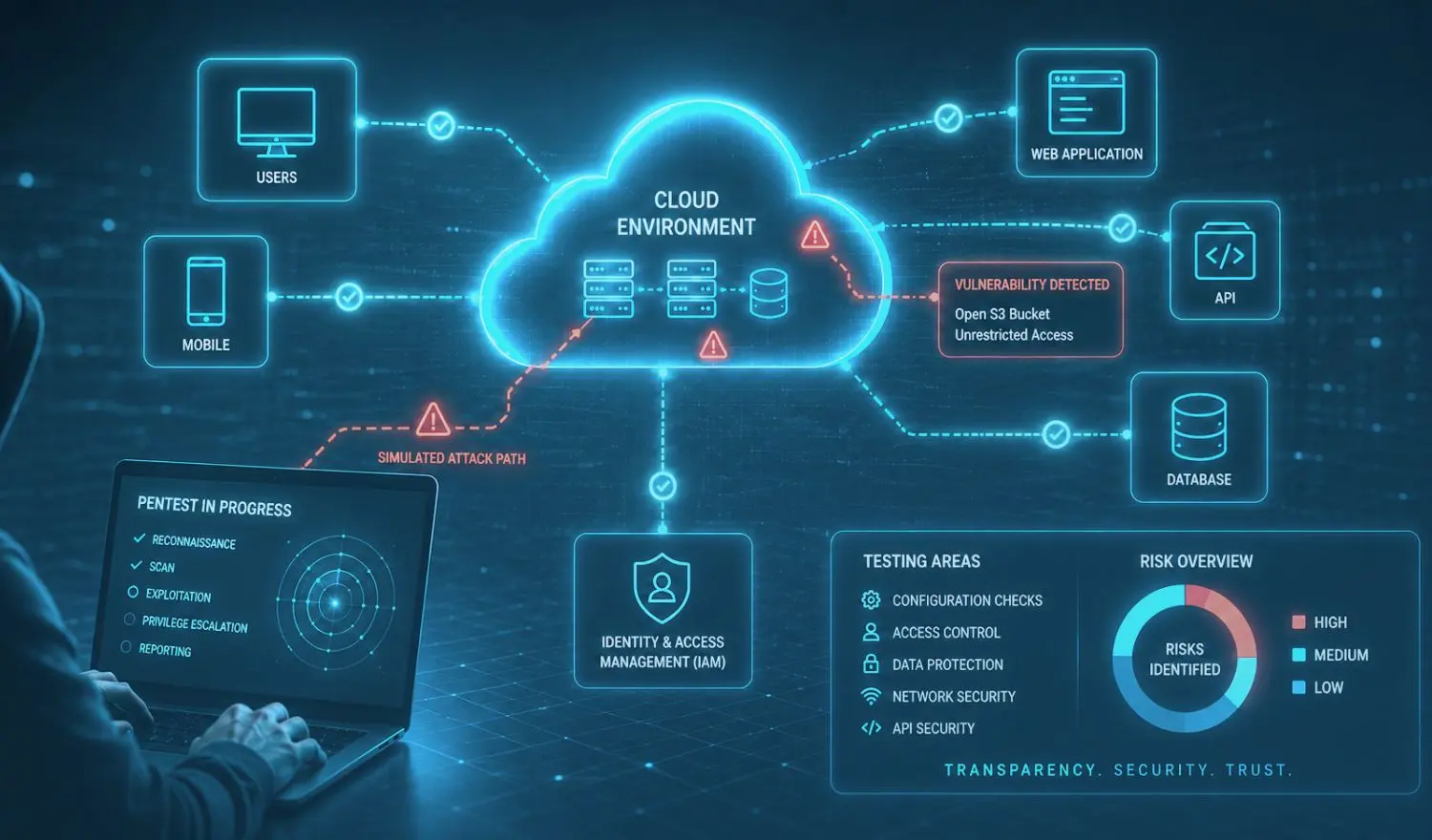

Security Assessment in the Cloud
What is cloud pentesting and how does it differ from classic penetration testing?
A penetration test simulates a real cyber attack in order to identify vulnerabilities in IT systems, applications or networks. The aim is to uncover security gaps before real attackers discover and exploit them.
Cloud pentesting focuses on systems and data operated in cloud environments. Alongside the technology, access rights, misconfigurations, API interfaces and cloud-based identity services play a central role here.
The biggest difference: Not everything that is tested belongs to the company itself. In classic infrastructures, companies control the entire environment. In the cloud, they often work with IaaS, PaaS or SaaS services, where part of the responsibility lies with the provider.
An example: With an on-premise system, you operate the firewall entirely yourself. In a cloud environment, it may be part of the cloud provider's service and may not be actively tested at all without its consent.
That is why a clear understanding of responsibilities is essential in cloud pentesting. Key concept: the Shared Responsibility Model.
Objectives, benefits and responsibilities: what cloud pentesting really delivers
Cloud pentesting pursues several key objectives:
- Uncovering technical vulnerabilities: misconfigurations, unprotected interfaces, unencrypted data transfers and weak authentication are identified.
- Ensuring compliance: many industries are subject to security standards (e.g. ISO 27001, FADP, GDPR). A documented pentest demonstrates that measures have been taken.
- Preventing financial damage: security gaps can lead to data loss, reputational damage or business interruptions. Pentesting helps you act preventively.
- Raising awareness among IT teams: vulnerabilities often arise from carelessness or lack of knowledge. The testing process itself often has an educational effect.
At the same time, the question arises: who is responsible for what?
The Shared Responsibility Model divides responsibilities between the cloud provider and your company:
- The provider secures the physical infrastructure, networks and basic services.
- The company is responsible for applications, user rights, data and access rules.
A pentest must take precisely this division into account. Important: in many cases, the provider's permission is required.
Methods and process of a cloud penetration test
Depending on the objective, different types of tests are used:
Black box tests: The tester has no knowledge of internal details, which makes for a realistic attack simulation from the outside.
White box tests: The tester receives credentials and system information, allowing a more in-depth assessment.
Grey box tests: A combination of both approaches, often particularly true to real-world conditions.
Specialised tests: Focus on API interfaces, cloud identities (IAM), databases or network configurations.
A typical test is divided into several phases:
- Planning and approval
Defining the test objectives, obtaining consent from the cloud providers, coordinating timing. - Information gathering (reconnaissance)
Collecting publicly available data and analysing the attack surface. - Vulnerability analysis and attack simulation
Attempting to break into systems or escalate privileges without causing damage. - Evaluation and reporting
Documentation of all vulnerabilities found, including risk ratings and recommendations for action.
When is the right time, and how does your company get started with cloud pentesting?
The best time for cloud pentesting is not after a security incident, but:
- before a new application goes live,
- after major architectural changes,
- during migrations to the cloud,
- or regularly as part of your security strategy.
SMEs should work with an experienced security partner who understands both the technical depth and the organisational processes, and who knows how to test in coordination with cloud providers.
A good starting point is an initial assessment, which reviews your current state and delivers a roadmap for targeted testing. Modular tests follow, matched to your budget and maturity level.
Security starts with transparency and the right test strategy
Cloud technologies offer enormous opportunities, but only if they are properly secured. Professional cloud pentesting creates transparency, uncovers risks and shows you concrete ways to improve.
Would you like to know how your company can get started in a targeted way?
Contact us and we will guide you step by step to the right cloud pentest.