
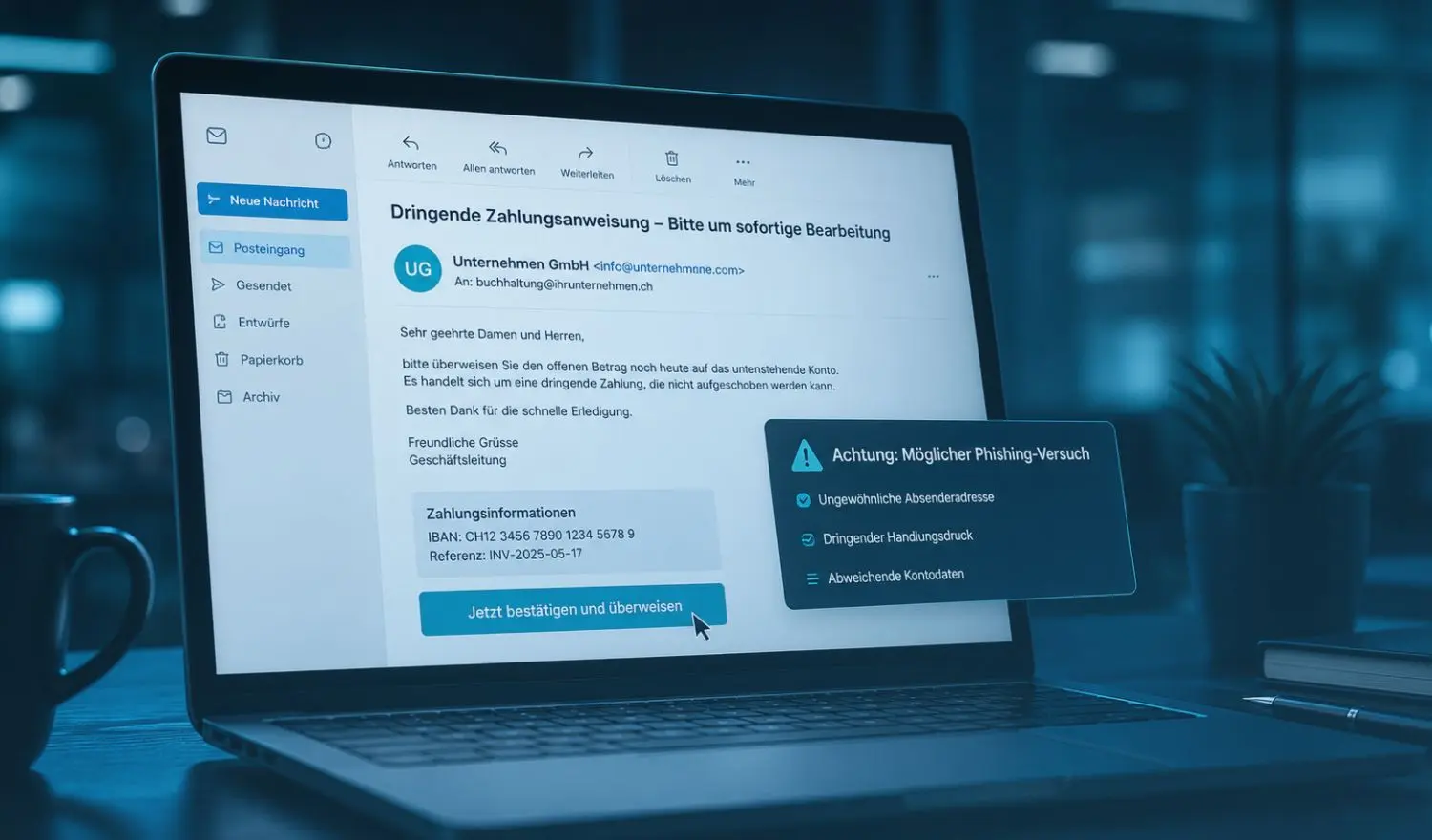

Phishing is not an IT problem, it is a leadership problem. Most attacks on small and medium-sized enterprises (SMEs) do not succeed because someone was gullible or an antivirus scanner failed. They succeed because processes are missing, responsibilities are unclear and warning signs are not taken seriously.
Phishing has become professional. Today's attacks are targeted, technically inconspicuous and often deceptively plausible. They are aimed at specific roles in the company, for example in accounting, purchasing or the executive assistant's office. Precisely where decisions are made and money is moved.
This article shows you how to recognise phishing before it becomes a threat: with systematic early detection, coordinated procedures, trained staff and targeted use of technology. Because what matters is not whether a phishing email arrives, but whether it gets through.
Phishing has long been precisely organised, and SMEs are a prime target
Current phishing campaigns are no longer generic but tailored exactly to the target company. Attackers use publicly available information: legal notices, social media profiles, industry news, job advertisements. From this they build credible emails with genuine context, such as messages from supposed suppliers, internal requests or contract discussions.
But why SMEs in particular? Because they often use hybrid IT structures (internal systems plus cloud services), have no dedicated security teams and are understaffed. Many SMEs work with outdated communication channels, insecure file formats or shared mailboxes. This makes targeted attacks easier.
The most common forms:
- Business Email Compromise (BEC): Deceptively genuine instructions issued in the name of senior management
- Credential Harvesting: Login screens for Office 365, Dropbox or internal ERP systems
- QR phishing: QR codes on fake invoices or in emails that lead to manipulated logins
- Vishing & callback phishing: Calls in which attackers pose as IT support, often referring to emails sent earlier
The danger lies not in the individual case but in the system behind it. If you understand that structure, you can counter it in good time.
Early detection instead of reaction: what companies need to do proactively
Early phishing detection means recognising potential attacks before they cause damage. This only works if your business processes are designed for it. What matters is that no single person is held solely responsible, and that the system backs up the decision.
Three principles are central:
- Channel separation for critical communication
Payment approvals, password changes or access grants must not be made by email alone. Internal systems, secure messengers or a defined call-back procedure are a must. - Clear roles and approval levels
Who may approve what? From what amount is a second pair of eyes required? Are there documented deputy arrangements? If not, every phishing email becomes an invitation. - Reporting and escalation mechanisms
People must be able to report suspicions. Quickly and without bureaucracy. A button in the email client, an internal ticketing system or an IT hotline with a clear response time make the difference.
A working early warning system does not just detect individual incidents, it identifies patterns. And that is only possible with a structured, documented approach.
Empowering employees with practical awareness that works
Security awareness does not develop overnight. It grows through clear information, recurring prompts and a company culture in which questions are welcome and thinking along is encouraged.
What matters is that awareness is not seen as an additional burden but as a helpful part of everyday work. Modern formats rely on targeted, practical learning units that meet employees where they are, regardless of their role or IT experience.
What works in practice:
- Short, regular learning formats that are easy to fit into everyday work
- Realistic phishing simulations that create concrete learning situations and allow for reflection
- A positive approach to mistakes, which makes it easier to report uncertainties and encourages active engagement
- Visible communication on current risks, e.g. through IT notices, intranet posts or short status updates
Awareness works particularly well when it stays alive and does not become a one-way street. Questions, feedback and experience reports from the team are valuable indicators for lastingly strengthening security behaviour.
How n’cloud and n’guard support you: Our awareness training is tailored specifically to the needs of SMEs: easy to understand, immediately actionable and closely tied to practice. Whether as interactive online modules, on-site training or targeted campaigns, we help you build an awareness that goes beyond individual measures.
A security culture develops step by step. With the right support, it does not become an extra burden but a natural part of your organisation. We at n’guard are happy to support you: reliably, clearly and with a focus on solutions.
Using technology in a targeted way
Technology plays a central role in phishing defence when it is properly integrated. Many SMEs rely on “plug and pray” solutions: an antivirus programme, a spam filter. And nothing else. That is not enough.
Technology is effective when it is part of a security concept:
- Email gateways with attachment analysis and URL rewriting
Fake links and dangerous attachments are neutralised before delivery. - Sandboxing of attachments
Office documents and PDFs are automatically tested in isolated environments before they are opened. - Endpoint Detection & Response (EDR)
Suspicious activity such as unusual login times or unexpected file transfers is detected and reported automatically. - Two-factor authentication, without exception
Login credentials alone must never grant access. Cloud services and admin accounts in particular must be secured without fail.
But technology is no substitute for processes. A well-configured email filter will not stop a transfer that was approved via WhatsApp. And a SIEM system is of no use if nobody responds to the alerts.
Phishing is here to stay. The only question is whether your company is prepared. If you want to put your structures to the test and build genuine resilience, we are happy to support you: technically sound, organisationally well thought out, and without empty promises.