

Endpoint Detection and Response (EDR) for modern SMEs
The threat landscape in the digital space is constantly changing, and with it the requirements for effective IT security. Conventional protection mechanisms such as antivirus programs or simple firewalls are often no longer enough to protect companies reliably against attacks.
Small and medium-sized enterprises (SMEs) in particular face the challenge of securing their endpoints better: efficiently, practically and without excessive complexity. This is where Endpoint Detection and Response (EDR) comes in.
EDR solutions do more than block threats. They actively detect and analyse them and respond in a targeted way, before a vulnerability turns into serious damage.
This article explains what EDR actually does, why SMEs benefit in particular and what a successful integration looks like.
Why traditional protection is no longer enough
For a long time, it was enough to protect endpoints with antivirus software, recognise known patterns and block malicious programs. But attacks have become more varied and more dynamic.
Cybercriminals exploit zero-day vulnerabilities, combine social engineering with technical attacks and develop malware that constantly changes in order to bypass traditional protection mechanisms.
On top of that, more and more employees work remotely, access company data from various devices or use cloud services. The boundaries of the corporate network are becoming blurred.
In this environment, it is no longer enough to react only to known threats. Modern security must detect when something unusual happens, even if the threat is still unknown.
Endpoint Detection and Response starts right here: with continuous monitoring, rapid anomaly detection and targeted countermeasures.
What Endpoint Detection and Response does better
EDR systems fundamentally change the way we look at security.
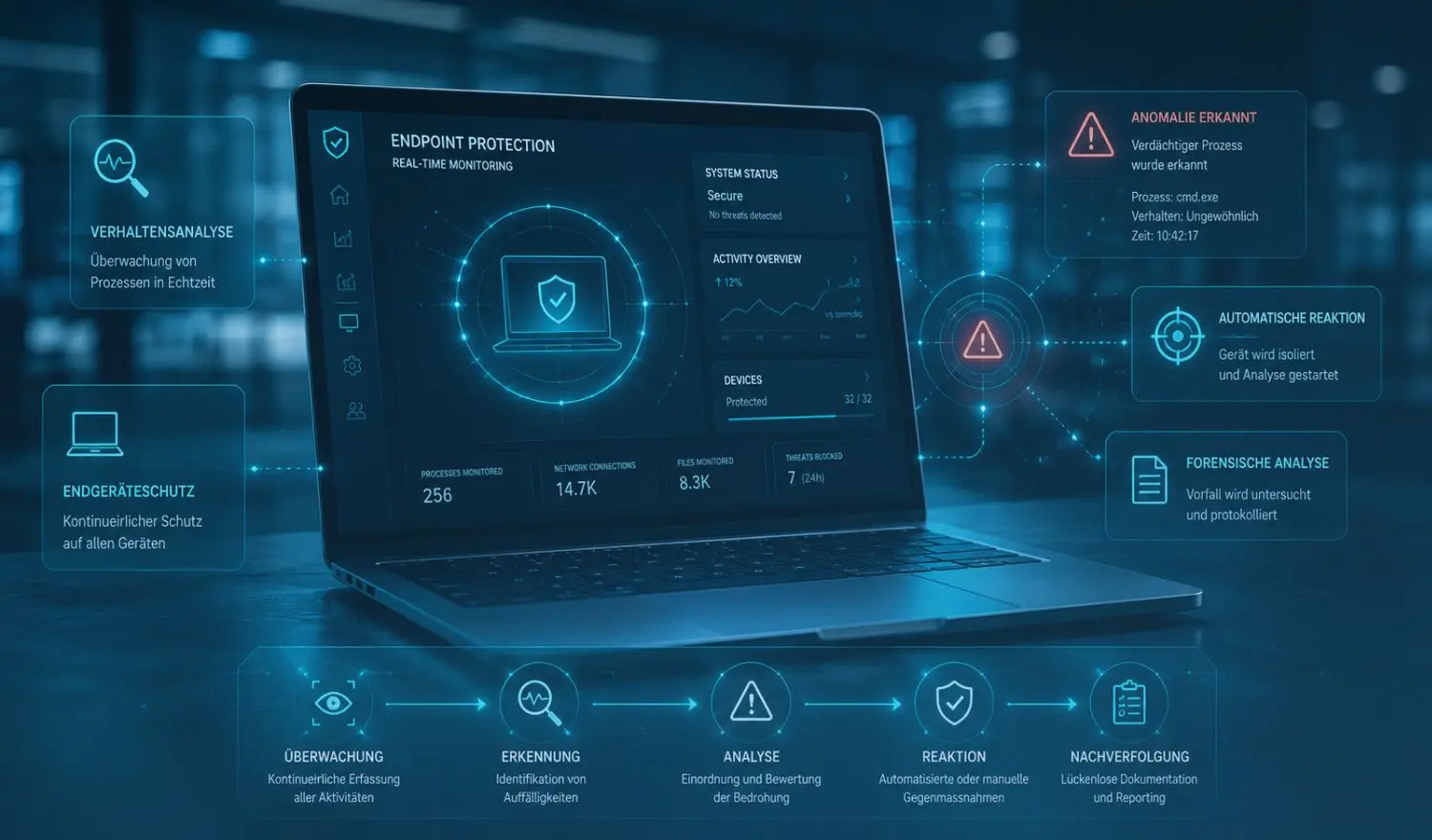
Instead of relying on recognising and blocking known malware, they continuously observe what is happening on endpoints.
Unusual processes, unexpected network connections or conspicuous data movements are not assessed in isolation, but analysed in context.
This continuous analysis adds a new dimension to security:
If a device suddenly starts encrypting large volumes of data, or establishes a suspicious connection to an unknown server, the anomaly is detected immediately. As a next step, automated measures can be triggered, for example isolating the affected device straight away, before an attack can spread further across the network.
For small and medium-sized enterprises in particular, this marks a noticeable change in their protection concept. You can react faster, intervene in a more targeted way and gain insight into processes that often used to remain hidden.
And last but not least: protection no longer stops at the office door. Employees who work from home, on business trips or at changing locations are also integrated into the security architecture, without complicated detours or separate add-on solutions.
How your company can integrate EDR successfully
Introducing an EDR solution does not require a complete overhaul of your IT, but it does require deliberate planning. The path to effective integration can be divided into several steps:
- Analysing the current state:
Which endpoints are in use in your company? Where is your critical data stored? Are endpoint protection systems already in place and, if so, which ones? - Choosing a suitable solution:
Not every EDR solution is the same. It is important to choose a technology that suits both the size and the way of working of your company, ideally one in which the traditional protection functions (such as antivirus protection) are already integrated. - Phased introduction:
Particularly in smaller organisations, it has proved effective to introduce EDR first on a subset of devices and then roll it out step by step. This allows you to gather experience and adjust processes where necessary. - Involving employees:
EDR relies not only on technology, but also on awareness. A short training session helps to avoid misunderstandings and makes the benefits transparent.
Ongoing monitoring and adjustment:
EDR is not a one-off installation, but a continuous process. Regular reviews help to keep your protective measures up to date and to improve them continuously.
How to recognise a good EDR solution
The market for EDR solutions is large, but not every technology is equally suitable for small and medium-sized enterprises. If you are looking for a solution that protects reliably and fits into everyday operations, you should pay attention to a few key features.
A good EDR platform combines traditional antivirus protection with modern attack detection and active response. Only when protection, detection and defence work together seamlessly can you avoid integration problems and additional effort.
- For SMEs in particular, usability is also a decisive factor. Clearly designed dashboards, understandable alerts and clear recommendations for action make the system easier to use and enable rapid responses, even without a large IT department.
- Automated processes are another mark of quality. Good systems isolate compromised devices on their own, stop suspicious activity and at the same time let you trace incidents individually and learn from them.
- Scalability should not be underestimated. Whether you have ten devices or a hundred, the solution should adapt flexibly as your company grows, without requiring a complete switch.
- A transparent cost structure provides planning certainty. Hidden fees or confusing licensing models are a risk, especially for smaller businesses, and one that can be avoided.
One example of such a balanced solution is WatchGuard EPDR. It combines comprehensive endpoint protection with advanced attack detection and response mechanisms in a single platform tailored specifically to the needs of small and medium-sized enterprises. Thanks to the close integration of protection and response, the solution stays easy to handle, security remains comprehensive and administrative effort is low.
If you would like to assess how Endpoint Detection and Response can be integrated sensibly into your company, we will be glad to support you: pragmatic, hands-on and with a clear eye for what really protects.