
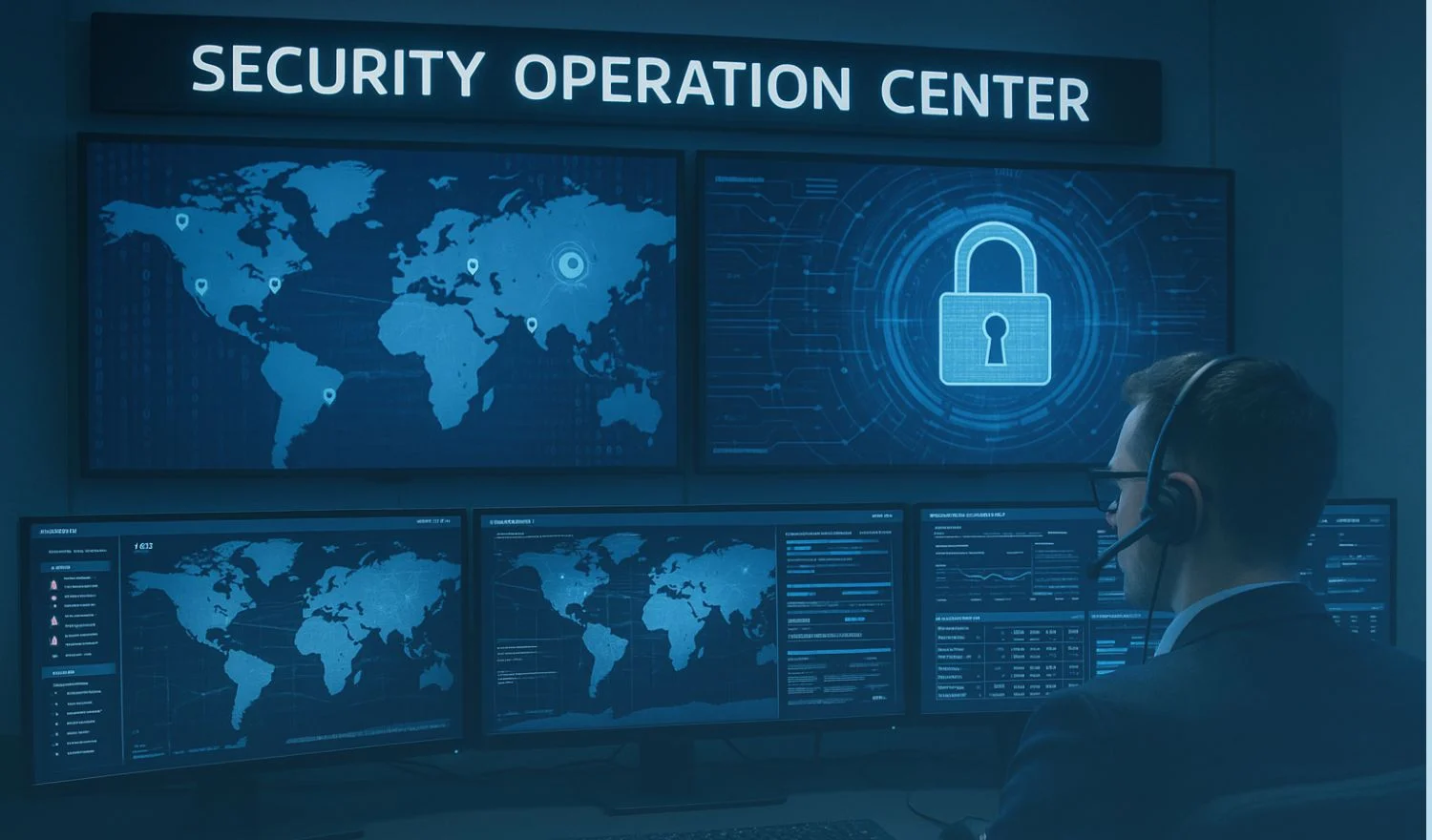

Many mid-sized companies have developed significantly in digital terms in recent years. At the same time, the number of security-relevant incidents has risen. Often unnoticed, sometimes with serious consequences. Despite all the protective measures, many questions remain unanswered: Who detects suspicious activity before it becomes a problem? Who responds when an incident occurs, and how quickly?
It is precisely in this tension that the concept of the Security Operation Center (SOC) is gaining importance. Not as an add-on for large corporations with their own IT department, but as a realistic complement for companies that need reliable answers to security questions in their day-to-day operations.
What is a SOC and why is it becoming more important?
A Security Operation Center is the central point of contact for all security-relevant events in an organisation. It continuously monitors, analyses and assesses security-relevant information from the IT infrastructure. The aim is to detect attacks early, classify them correctly and respond effectively.
While traditional security solutions such as firewalls or antivirus programs are designed to block known threats, a SOC complements them with a more holistic view:
Suspicious activity, unusual patterns and interconnected events are examined in context. This also makes it possible to identify more complex or previously unknown attack scenarios.
The growing use of cloud services, remote workstations and decentralised systems means that attack surfaces are growing. At the same time, many companies no longer have a complete overview of their digital risk. This is where a SOC creates a new kind of visibility and ability to act.
Typical day-to-day tasks of a Security Operation Center (SOC)
The work of a Security Operation Center can be broadly divided into three functional areas: detection, assessment and response.
- Detection:
A SOC continuously collects data from a variety of sources, such as firewalls, endpoint protection systems, authentication services or applications. These logs are correlated centrally and matched against current threat intelligence. - Assessment:
Not every alert is a genuine incident. SOC analysts check whether it is a false alarm, whether a new vulnerability has been exploited or whether a targeted attack is under way. Experience plays a decisive role here. - Response:
In an emergency, the SOC initiates countermeasures. Depending on the model, it either informs the company's IT team or directly coordinates the first incident response steps. These include isolating affected systems, locking user accounts or blocking specific connections.
In addition, a SOC documents all incidents and measures. These reports are important not only for internal analysis, but also for communicating with partners, customers or, in the event of a serious incident, supervisory authorities.
Why a SOC is both sensible and feasible for SMEs
Many medium-sized companies assume that a SOC is too costly, too time-consuming or simply too complex for their organisation. This view often dates from a time when security operations centres were indeed run only by large corporations with their own IT departments.
Today there are new models that give smaller companies access to SOC services as well. The key lies in pooling resources and using modern technologies that automate analysis and response, making them scalable.
SMEs benefit in several ways:
- Early warning system: A SOC detects suspicious activity before it causes damage. This significantly improves your ability to respond.
- Transparency: Companies gain a better understanding of their own IT landscape and potential vulnerabilities.
- Relief: Responsibility for monitoring no longer rests solely with internal teams, who are usually busy with other tasks.
- Documentation and traceability: Security incidents are logged in a traceable way, a prerequisite for many regulatory requirements.
Of course, a critical assessment remains important. Not every company needs the same depth of monitoring and analysis. But if you process sensitive data, interact with customers through online services or depend on your systems functioning, you should not put off the question of a SOC.
Integrating a SOC into existing security concepts
A SOC does not replace existing protective measures. It complements them where conventional systems reach their limits: in correlating information, assessing context and coordinating the response.
Especially in medium-sized environments, it is important that a SOC model fits into existing structures without turning everything upside down. Many companies already have firewalls, endpoint protection or patch management in place. A SOC builds on these and creates a coordinated view of security-relevant events.
For this to work, a SOC service should offer the following:
- Technical compatibility with your existing infrastructure
- Clear escalation paths and communication processes
- Transparent reports that are easy to follow even without in-depth expertise
- Adaptable response models tailored to your company
In practice, there are various options: from a partially automated alerting model with monthly analysis to a round-the-clock service with the authority to intervene directly in an emergency.
In Switzerland, too, there are now providers that offer SOC services in modular form, for example as part of a comprehensive Cyber Security as a Service model. Such offerings allow your SME to expand its protection in a targeted way, without being overwhelmed in terms of staff or organisation. For small and medium-sized companies in particular, a SOC can make the difference. Not through the size of the system, but through the quality of its integration.