

For a long time, one core principle applied in IT security: anyone who had authenticated once on the company network was largely free to move around within it. Internal connections were considered trustworthy, external ones potentially dangerous. But this model dates from a time when networks were closed, workstations were fixed and systems were manageable.
Today, much is different. Employees work from home or on the move. Data sits in the cloud, on local servers and in SaaS applications. The classic network perimeter has dissolved, and with it the trust once placed in "internal security".
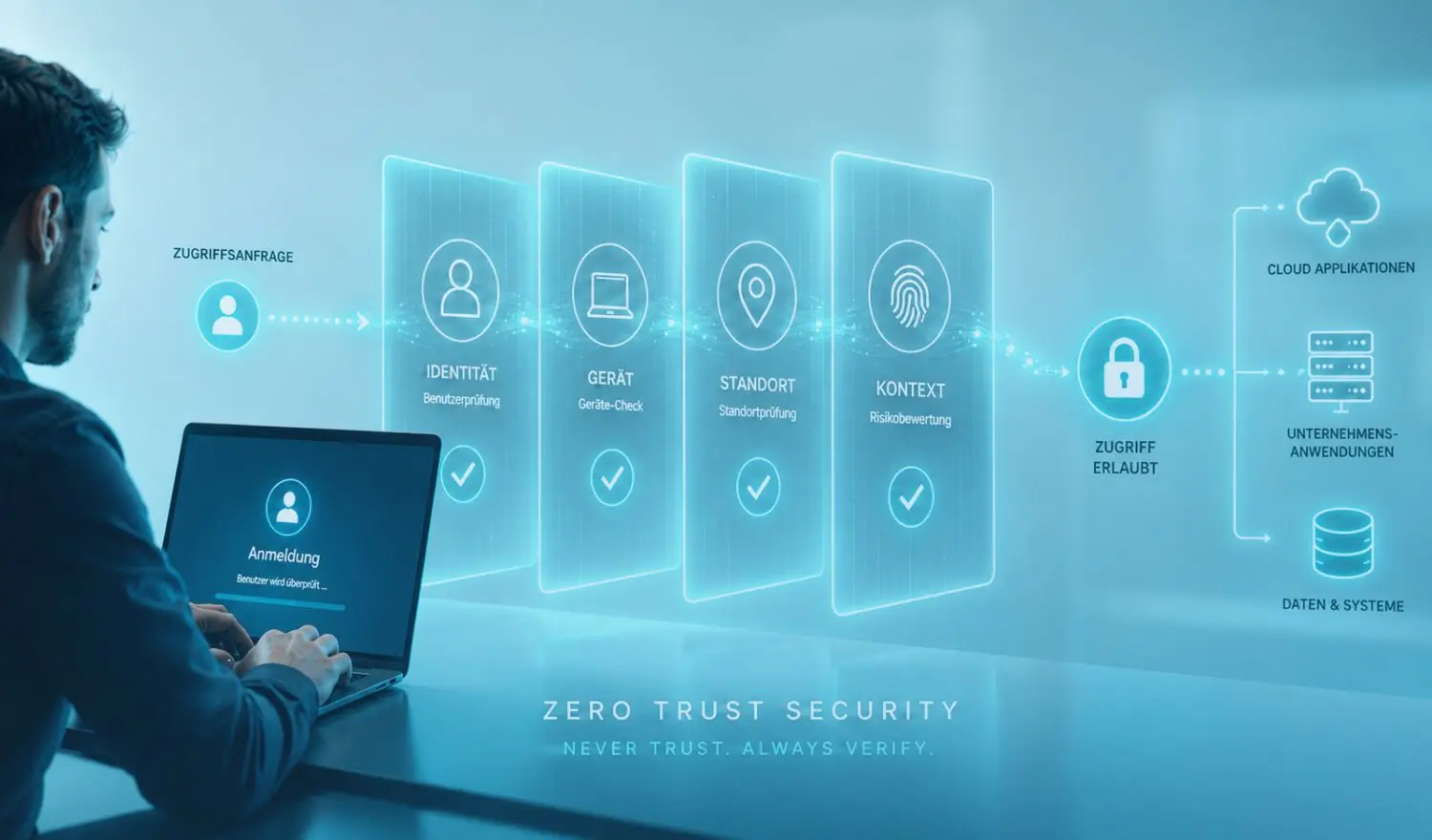
Zero Trust Security responds to these changed conditions with a fundamentally different security concept. Instead of presupposing trust, it demands: "Never trust, always verify." What sounds simple means a paradigm shift in practice. And it is at the same time a pragmatic way of dealing with the challenges of modern IT environments.
What does Zero Trust Security mean, and why is the model more relevant than ever?
Zero Trust Security is not a product but a strategic security approach. It is based on the assumption that no user, device or connection is trustworthy per se, not even within your own network. Trust must be earned anew at all times, through identity verification, contextual assessment and continuous monitoring.
The model has gained considerable importance since 2020 in particular. The rapid shift to home working, increasing cloud use and the growing number of targeted attacks on mid-sized companies make it clear: the classic firewall is no longer enough. What was once conceived as a "secure perimeter" has developed cracks in practice. Often where nobody is looking.
This is exactly where Zero Trust Security comes in: security is no longer defined by location or network, but by clear rules, verifiable identities and continuous monitoring.
The core principles of Zero Trust in everyday business
The essence of Zero Trust Security can be summarised in three guiding principles:
- Verify instead of trust
Every access request, whether from inside or outside, is checked. It is not only the password that counts, but also the context: Is the device known? Is the access plausible for this role? Is the location unusual? - Access based on the principle of least privilege
Users receive exactly the rights they need to do their work. Permanent admin rights or global permissions are avoided. Rights are reviewed regularly and withdrawn where necessary. - Segmentation and continuous monitoring
Networks are divided into smaller, logically separate areas (microsegmentation). This helps contain the spread of an attack, even if an access point has been compromised. At the same time, activities are continuously logged and analysed.
These principles can be applied to different areas of IT. From access to files to the use of cloud applications, from the behaviour of individual endpoints to the management of administrative rights.
The concrete benefits of Zero Trust for SMEs
At first glance, Zero Trust Security may seem like a concept for large enterprises. Yet small and medium-sized enterprises (SMEs) in particular benefit from it, because they often have no security teams of their own and have to rely on simple but effective protection mechanisms.
The key benefits at a glance:
- Reduced attack surface
Restricting rights and consistently verifying every connection lowers the likelihood of an attacker spreading through the system, even when credentials have been compromised.
- Protection against insider threats
Not every threat comes from outside. Employees with excessive rights or unintentional misconduct can cause serious damage. Zero Trust sets targeted limits here.
- Greater transparency and better traceability
Logging access and decisions creates a clearer picture of how IT is used in the company. In an emergency, you can quickly establish what happened. This is an advantage for internal review as well as for audits or legal requirements.
- Meeting regulatory requirements
Particularly in the context of the new Swiss Federal Act on Data Protection (revFADP) or the GDPR in Europe, traceability, access control and protective measures are key points. Zero Trust creates a robust foundation for them.
- Better protection for remote working and cloud use
Traditional VPN solutions often reach their limits in modern scenarios. Zero Trust lets you give users secure, targeted access to individual services or applications, regardless of where they are or which device they use.
What companies should bear in mind when introducing it
Zero Trust Security is not a switch you can simply flip. It is a concept that can be integrated step by step into your existing IT structure. What matters is a realistic and strategically sensible starting point.
- Current-state analysis and prioritisation
Which systems are particularly critical? Which user groups have extensive or unclear permissions? Which applications are already cloud-based? Taking stock helps you implement the first measures in a targeted way. - Identity management as the foundation
Without clear identities, Zero Trust cannot be implemented. Companies should ensure that user accounts are clearly assigned, reviewed regularly and, where necessary, can be blocked automatically. Multi-factor authentication should be the standard, not the exception. - Gradual introduction instead of a complete overhaul
Zero Trust can be approached in modules. For example, you can start with particularly sensitive applications or with user groups that pose an increased risk. What matters is this: every improvement counts, even small ones. - Integration into existing security solutions
Zero Trust does not replace existing measures, it complements them. Good patch management, endpoint protection and a well-configured firewall remain important. Zero Trust helps to link them together in a meaningful way. - Communication and training
Introducing new security mechanisms can meet with resistance, for instance when processes become more complex or habits are questioned. Transparent communication, understandable rules and targeted training help to build acceptance.
Zero Trust Security is not a box you buy and plug in. It is a way of thinking that can be applied to many areas of corporate IT. Those who start thinking in Zero Trust terms will, in the long run, change how security is understood and practised across the company.